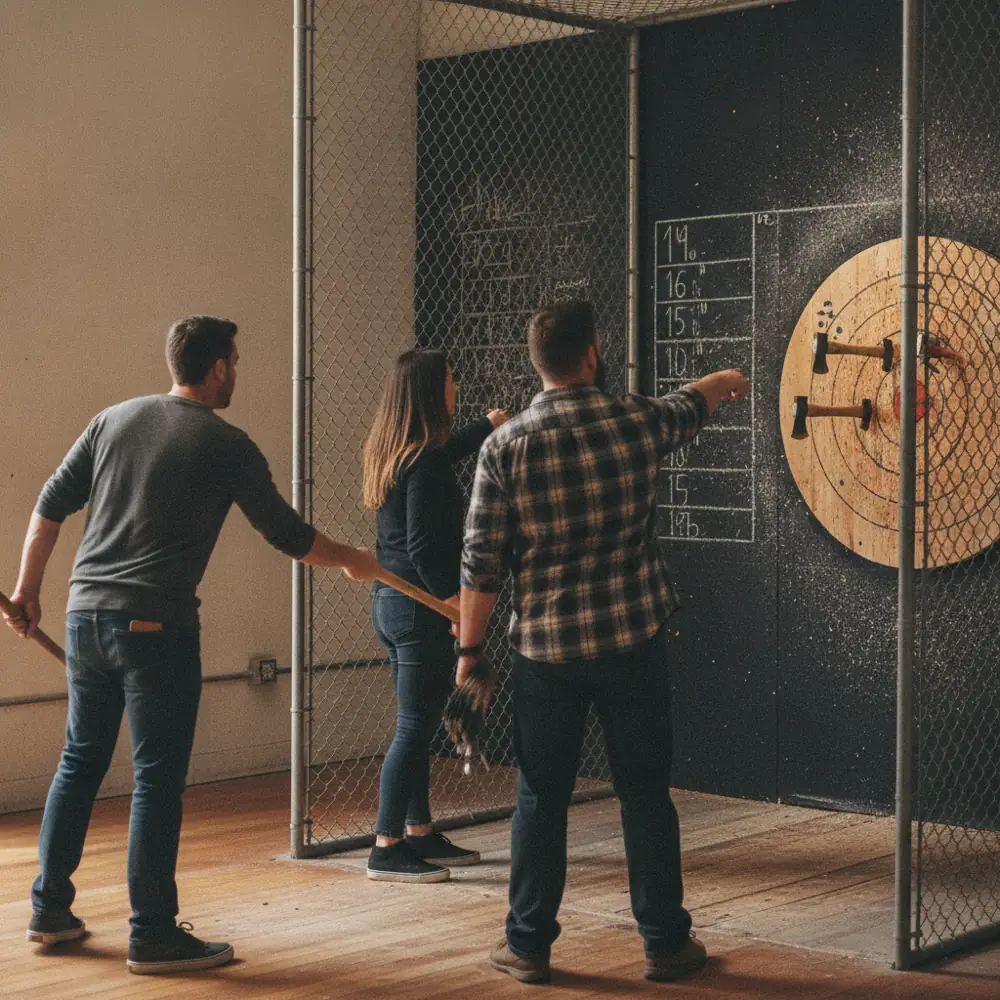
No lane is offered without a coach free to run it
The coach and the lane are one booking. When both of your coaches are on at eight, the third lane is not offered at eight, so nobody buys a session you cannot legally run.
A session is a lane, a coach and a group, and Picktime holds all three against the same booking, so a Friday night slot is only ever offered when there is somebody rostered to run it. Groups take the places they need in one action, the deposit is taken while they book, and a lane handed back goes to whoever is waiting.

Blu AxeBook online
Coached session1h · Lane 2$35.00
Walk-up hour1h · Lane 1$28.00
Group of eightTwo lanesBook
Next free6:00 PM7:00 PM8:00 PM
Lane and coach
Both free
Or the session is not offered
Deposit
$70.00
25% on a group of eight
Places left
4 of 12
Places counted, not bookings
Everything here comes from one fact about this trade: a lane cannot be sold unless somebody qualified is standing on it for the whole hour.
The coach and the lane are one booking. When both of your coaches are on at eight, the third lane is not offered at eight, so nobody buys a session you cannot legally run.
A works do for eight takes eight places at once, across as many lanes as it needs. The number on the page is the number of spaces you actually have left, and there is one booking to move if they change the date.
Take the full price or a deposit at the moment somebody books, through a payment provider you connect. The Friday lanes are held once the money is through, which is what a group booking made in a group chat never was.
A confirmation when they book, and on the paid plans a reminder before the night, each carrying the address, the arrival time and whatever you need people to know before they get here: closed shoes, and how early to turn up.
A lane holds a set number of throwers, so a group bigger than one lane is a booking across two, and the page has to know that before it takes the money.
Picktime counts the places rather than the bookings: twelve people is two lanes and two coaches for the same hour, and if the second coach is not free that hour is not offered at all.
You publish the session times you want as well, so the fifteen minutes between one group leaving and the next being briefed is already in the timetable people book from rather than something you hope for.
Friday and Saturday nights are the business, and a group cancelling on Wednesday is only a loss if the lanes stay marked as taken.
The confirmation carries a link to cancel and reschedule, so the organiser moves it themselves.
The lanes go straight back onto the booking page, and on the paid plans the people who tried for that slot when it was full are on a waiting list, waiting to be offered exactly this. That is what turns a midweek cancellation into a full Friday rather than two dark lanes.
Twenty to eight on a Friday. Two lanes are running, each with three people on it, because both were booked by phone as “a few of us”. There are eight people at the door who rang on Wednesday and were told to just come down.
Nothing about that night was ever a number. It was three conversations, none of which agreed with the others, and none of which had any money attached.
Picktime counts places rather than bookings, holds the coach with the lane, and takes a deposit at the moment somebody books.
6 of 12Places sold on the two lanes running
8People at the door with nothing to book on to
Add each lane with the number of throwers it takes and the hours it runs. Then add your coaches, because a lane without one is not a session you can sell.
Publish the start times you actually run (on the hour, on the half hour) with the length of a session and its price. Say what has to be paid up front, and how late a group may cancel.
The booking page is a link, so it goes on your site behind a Book Now button, in your Instagram bio and in the Google Business profile people find at eleven at night. A works do books itself.
The calls that decide a Friday come in on a Tuesday afternoon, from somebody organising fourteen people who has three venues open in three tabs.
The free plan is a plan, not a trial. There is no date at which it stops, no card to add, and nothing that quietly turns off in a fortnight.
A session lands in the calendar you already have open, and the paid plans sync it both ways, so when it moves there it moves here. Put a Book Now button or a booking widget on your own site, and link it from the social profiles where most group bookings actually start.
Picktime runs in a browser on a phone as well as a laptop, and there are iOS and Android apps, so whoever is on the floor can see the nine o’clock group without going to the desk.
The test that separates them is whether the software can refuse to sell a lane when there is no coach free to run it. A general booking tool books a time; an axe throwing session needs a lane and a person, together, for the whole hour. Picktime books both as one thing and the free plan covers a single venue.
Most of this category charges per staff member or per venue, and some of it takes a cut of every booking on top. Picktime has a free plan with no card and no end date, and what each paid plan adds is set out in full on the pricing page.
Yes. Picktime’s free plan gives you a booking page for your sessions, lanes and coaches held together and a place count on each session, with no card and no end date. There are iOS and Android apps as well as the browser version.
Yes. Picktime counts places rather than bookings, so twelve people is two lanes and two coaches for the same hour, booked once. If the second coach is not free that hour, the hour is not offered.
Yes, through a payment provider you connect. Take the whole price or a fixed deposit and set it differently per session, so a group of twelve on a Friday can be held with money where a walk-up hour is paid in full.
The lanes go straight back on the booking page, where the next group looking at it takes them. On the paid plans the waiting list for that slot is offered them first. Every confirmation carries a link to cancel and reschedule, and you decide how late that is allowed to happen.
Yes, on the paid plans. The reminder before a session carries whatever you need people to arrive knowing (the address, how early to turn up, closed footwear), so the briefing starts on time instead of with somebody in sandals.
Judge it on what a single booking can hold. A stag party is one payment, twelve places, two lanes and two coaches for the same hour, and a tool that only counts bookings turns that into twelve rows somebody then has to keep together by hand. Picktime books the places, the lanes and the coaches as one thing and takes a deposit against it, and a party that rings instead of booking online can be put straight into the calendar.
Decide first whether you are buying a booking system or a ticketing tool, because they are not the same purchase and it is an easy one to get wrong. Ticketing sells places at a dated event and stops there. Booking system software has to hold a diary that repeats every week, know which coach is on, and let a Friday group move to Saturday without a refund and a fresh purchase. If your sessions run every week, you want the second, and Picktime is free for a single venue.
Rooms and groups A room, a time and a group of six, with the next game already timetabled.
See escape room scheduling
Tournament nights Tournament nights with a seat count, sold weeks out and staffed by name.
See gaming centre scheduling
Nights and hires Nights that sell out weeks ahead, held with a deposit rather than a promise.
See club event schedulingFree forever for one venue. No card, no trial clock, and Friday can be bookable this afternoon.