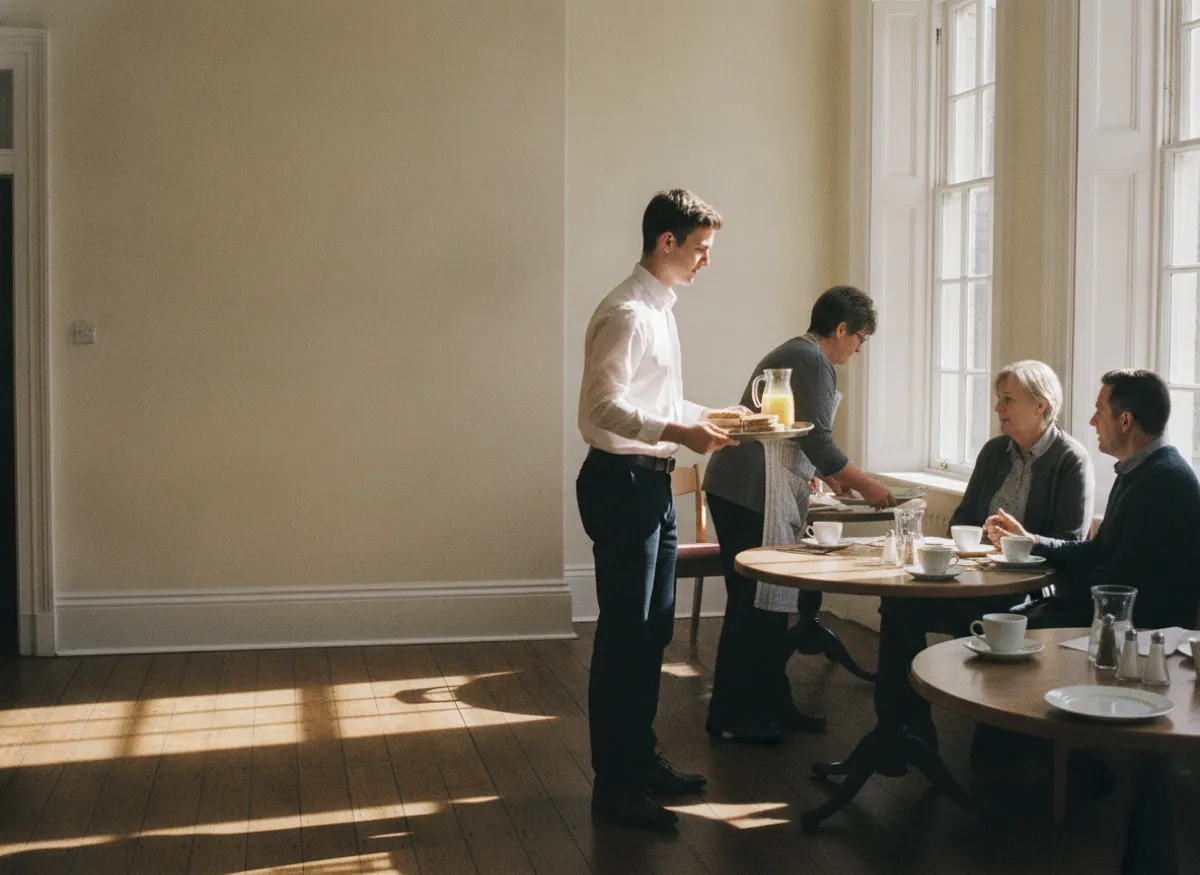
Breakfast sittings that fit the room and the kitchen
Two sittings, or three, each capped at what one person can plate. Guests pick theirs when they book, so the kitchen knows the numbers the night before instead of at twenty past eight.
A room-night is booked once. The breakfast sittings, the table for people who are not staying, the afternoon tea, the walking tour and the treatment room all turn over again and again, and they are usually the things still living in a paper diary by the hall phone. Guests book them themselves, capped at what the room actually seats.

Blu LodgeBook online
Dinner7pm · table of 4$46.00
Afternoon tea3:30pm · per head$28.00
Breakfast sitting8am · 2 leftBook
Next free12:30 PM3:30 PM7:00 PM
Nine o’clock sitting
2 covers left
Capped at what one pan plates
Private dining
$115.00
25% deposit on a table of ten
Allergies
Asked
Kept on the guest record
A bed and breakfast booking system usually means the room-night, and nothing here books one. All four are things a small guest house sells alongside the bed and currently writes in a book that only one person can read.
Two sittings, or three, each capped at what one person can plate. Guests pick theirs when they book, so the kitchen knows the numbers the night before instead of at twenty past eight.
Dinner, Sunday lunch or afternoon tea, bookable by anybody who finds your page, with the party size taken off the count in one go so the covers on the page are the covers you will lay.
Ask what you have to know while they are booking: allergies, a late arrival, a dog, a cot. It arrives with the booking and stays on the guest record, so a returning couple is not asked twice.
A private dinner for ten means a shop before it means a table. Take the payment or a deposit while they are booking, so the party that quietly stops existing has already paid for the beef.
A guest house is usually one or two people doing everything. If you are laying afternoon tea at four you are not taking a check-in at four, and if the treatment room is booked then whoever runs it is not in the kitchen. Everything you sell is set against the person or the room it actually needs, so an hour that is already spoken for is never offered again. The booking page stops selling you into two places at once, which a paper diary in the hall cannot.
A guest cancelling from their own confirmation puts the covers straight back on the page, and on the paid plans whoever is on the waiting list for that sitting is offered them first. Say how late somebody may cancel (a table at seven, a private dinner two days out) and the window does the arguing for you rather than a phone call you did not want to make. On a room that seats sixteen, one table back on a Saturday is not a small thing.
Ten past eight on a Saturday. Six guests came down at eight because nobody told them there were sittings, and the couple who asked for eight last night are standing in the doorway. There is one of you, the pan is on, and the phone in the hall has started ringing about a table for tonight.
The diary that would have prevented all three is on the hall table, and you are in the kitchen. It is not that the information does not exist. It is that it exists in one place, in one handwriting, and never where the question is being asked.
Picktime puts the sittings, the tables and everything else you sell on a page guests book from, caps each one at what the room holds, asks what you need at the point of booking, and takes the call you cannot get to.
Breakfast sittings and how many each seats, dinner and afternoon tea, the walking tour, the treatment room, the private dining table. Put the real number of covers against each, and the days it actually runs.
Add allergies, arrival time, dogs and cots to the booking form on the paid plans, so they arrive with the booking. Charge per head on the things you buy in for, hold a deposit on a private dinner, or take nothing at all.
The booking page is a link. It goes in your booking confirmation, on the card in the room, on your Facebook page and your Google listing, so the guest who is already coming books the table without ringing the hall phone.
The phone at a guest house rings while you are plating breakfast, while you are changing a room, and at ten at night. Picktime’s AI receptionist answers on a number of its own, around the clock, and takes several calls at once, so the Saturday morning that used to ring out is answered. It works out what the caller wants, captures their name and their number, guides them to a sitting or a table, and ends on a booking that lands in your calendar. If it is a question only you can answer, it transfers the call. Every call is transcribed, so the thing somebody said about a wheelchair or an anniversary is written down rather than half-remembered.
The free plan is a plan, not a trial. There is no date at which it stops, no card to add, and nothing that quietly turns off in a fortnight.
A table or a sitting lands in the calendar you already have open, and the paid plans sync it both ways, so when it moves there it moves here. Payments run through PayPal, and through Stripe or Square on the paid ones. The booking page goes on Facebook and your Google listing as well as your site, which is where somebody looking for a table on a Saturday is actually looking.
Picktime runs in a browser on a phone as well as a laptop, so you can see the evening’s covers from the kitchen rather than from the office, and there are iOS and Android apps if you would rather have one.
It depends which half of the business you mean. A property management system like Cloudbeds or Little Hotelier sells the room-nights and connects to the booking sites. Picktime is free and covers the other half (breakfast sittings, tables for non-residents, afternoon tea, tours and treatments), which is usually the half still being run from a diary in the hall.
Yes. Set each sitting and how many it seats, and guests pick one. Once a sitting is full the page says so, so eleven people cannot arrive for a room that lays eight.
Yes. The booking page is a link that anybody can use, with no account to make, so dinner, Sunday lunch and afternoon tea are bookable by the village as well as by your guests. A party of four takes four covers off the count in one action.
Yes, on the paid plans. Put allergies, arrival time, dogs and cots on the booking form and they arrive with the booking rather than at the table. They stay on the guest’s record, so a returning couple is not asked the same question twice.
Yes. Payment is set per thing you sell: per head on afternoon tea, a fixed deposit on private dining, nothing at all on a breakfast sitting. The booking is confirmed once the payment has gone through.
Yes. Everything is set against the person or the room it needs, so an hour that is already spoken for is not offered again. If you are laying afternoon tea at four, four o’clock is not on the page.
Yes. Each house keeps its own sittings, its own hours and its own booking page, and they all show in one calendar.
A property management system for the room-nights, and a channel manager to keep rates and availability in step with the booking sites. Both are built and priced for a business selling beds, and neither is much use for the sittings, tables and treatments a guest house also sells. Picktime takes that second list and leaves the rooms to whatever you already run.
A guest house usually ends up with three, and they do different jobs. Something to sell and hold the room-nights, something to keep the listing sites in step, and something for everything the guest books once they are staying: the breakfast sitting, the afternoon tea, the table on Saturday for six people who are not staying at all. Picktime is the third. It is worth being clear with yourself which of the three you are actually short of before you install anything, because the first two are a bigger purchase and the third is free to start.
If you mean the room-nights, we are the wrong people to ask and there is not much genuinely free in that category, because it is priced per room. If you mean everything that turns over more than once a day, Picktime’s free plan covers a small house: your own booking page, sittings and tables with their own capacities, guests moving their own bookings, and email confirmations, with no card and no end date.
We do not sell one, so we are not going to rank them for you. What is worth pinning down before you shop is where the line falls: a property management system owns the room-night, the rate and the connections out to the booking sites, and it stops at everything that turns over more than once a day. Picktime covers that second half, which is why the two sit beside each other rather than competing.
Covers Tables and sittings booked to the number the kitchen can actually plate.
See restaurant scheduling
Departures Walks with a headcount, booked from another time zone weeks ahead.
See tour guide scheduling
Treatments A therapist and a room that both have to be free before an hour is offered.
See spa schedulingFree forever for one guest house. No card, no trial clock, and tonight’s tables can be bookable in an hour.