
Key Takeaways
- A service-based business earns revenue by providing skills, expertise, time, or customer services, while a product-based business mainly earns revenue by selling physical or digital products.
- Service businesses often depend on appointments, staff availability, working hours, rooms, equipment, and customer relationships to manage daily operations.
- Product businesses usually focus more on inventory, production, storage, packaging, shipping, fulfillment, and product demand.
- Businesses do not always have to choose between services and products. A salon can provide appointments while selling hair care products, and a fitness studio can offer classes along with merchandise.
- Service businesses may have lower inventory costs, but their growth can depend on how effectively they use available staff time and booking capacity.
Before starting your business, you must know the difference between product businesses and service businesses. Just imagine the products you use every day, such as broadband, phone, laptop, skincare products, or kitchen appliances. On the other hand, service-based businesses earn revenue by providing services, skills, or expertise to customers.
Product-based businesses create their own products, sell them to customers, and continue to improve them over time. The model you choose directly impacts how your business earns revenue, manages expenses, organizes your team members’ schedules, and plans for growth. For example, a salon earns money by providing appointments, such as haircuts, nail extensions, hair coloring, and other salon services. For product-based businesses, an online store earns revenue by selling its products. Both can be equally profitable; however, they can have different costs, challenges, and growth opportunities.
If you understand the difference between these two business models, you can easily choose one. This will help you select a business model that matches your skills, budget, customers, and long-term goals. In this blog, we’ll explain what service and product-based businesses are, how they differ, and the pros and cons of each. By the end of this blog, you’ll have an overall idea of which business model might work for you.
Table of Contents
What Is a Service-Based Business?
A service business makes money by using skill, expertise, or experience rather than selling products. It relies on customer relationships, service quality, team availability, and the overall experience from the beginning. Business owners and team members provide services through appointments or scheduled sessions, managing time and employees. Also, customer management plays a crucial role in how the business operates and is managed. Common service industries include:
- Salons and beauty businesses
- Fitness studios and personal trainers
- Tutors and education providers
- Consultants and professional services
- Repair businesses
- Cleaning companies
- Wellness providers
- Clinics and healthcare practices
What Is a Product-Based Business?
A product-based business earns most of its revenue by selling items customers can purchase and use. These products can be physical items such as clothing, beauty products, furniture, equipment, or packaged food. Sometimes, product-based businesses also include templates, online courses, downloadable resources, or software licenses. The main difference is how sales connect to time. A product business can often sell the same type of item to many customers without assigning an employee to every individual purchase. For example, an online store can continue receiving orders outside its normal working hours.
Product businesses have their own costs and challenges. Owners often have to invest money upfront in buying products before they earn anything from sales. On the other hand, they also need to think about storage, packaging, transportation, and order fulfillment. Often, customers don’t purchase products as expected; that money can remain tied up in unsold inventory. This can also leave business owners with less money to spend on marketing, hiring, or other day-to-day business activities.
Pros and Cons of Service- and Product-Based Businesses
Service-Based Business Pros and Cons
| Service-Business Pros | Service-Business Cons |
| Lower inventory costs: Many service businesses do not need large amounts of physical stock, which can reduce upfront spending. | Capacity has a limit: Setting team schedules, working hours, rooms, equipment, and appointment slots limit how many customers a business can serve. |
| More personalized customer experiences: Employees can adapt services around individual needs, preferences, or goals, which helps businesses to build stronger relationships. | Scheduling issues can reduce revenue: No-shows, late cancellations, double bookings, and unused appointment times can leave valuable capacity unused. |
| Good potential for repeat business: Salons, clinics, consultants, tutors, and fitness businesses often serve the same customers regularly, creating opportunities for recurring revenue. | Growth can require more people or space: A growing service business may need more employees, longer operating hours, equipment, rooms, or locations to serve additional customers. |
💡Pro Tip: If you manage businesses that rely on services and face scheduling errors, an online scheduling tool, like Picktime, can really help. The system offers advanced features that save your time, reduce scheduling errors, and automate your scheduling operations.
Product-Based Business Pros and Cons
| Product-Based Business Pros | Product-Based Business Cons |
| More room to increase sales: Once a product is ready and the fulfillment process is running smoothly, a business can often sell more units without increasing labor at the same pace. | Unsold inventory can tie up money: If a business buys or produces more stock than it can sell, cash can get stuck in products sitting on shelves or in storage. |
| Access to customers beyond the local area: E-commerce allows product businesses to reach customers across different cities, states, and even countries, which can open the door to a much larger market. | Operating expenses can add up: Costs such as production, packaging, warehousing, shipping, and returns can take a significant share of revenue and reduce profit margins. |
| More consistent delivery: Standardized products can make it easier to give customers a reliable and predictable buying experience each time they place an order. | Demand can be hard to predict: Ordering too much can lead to excess stock, while ordering too little can result in missed sales and disappointed customers. |
Service-Based Business vs. Product-Based Business: What’s the Difference?
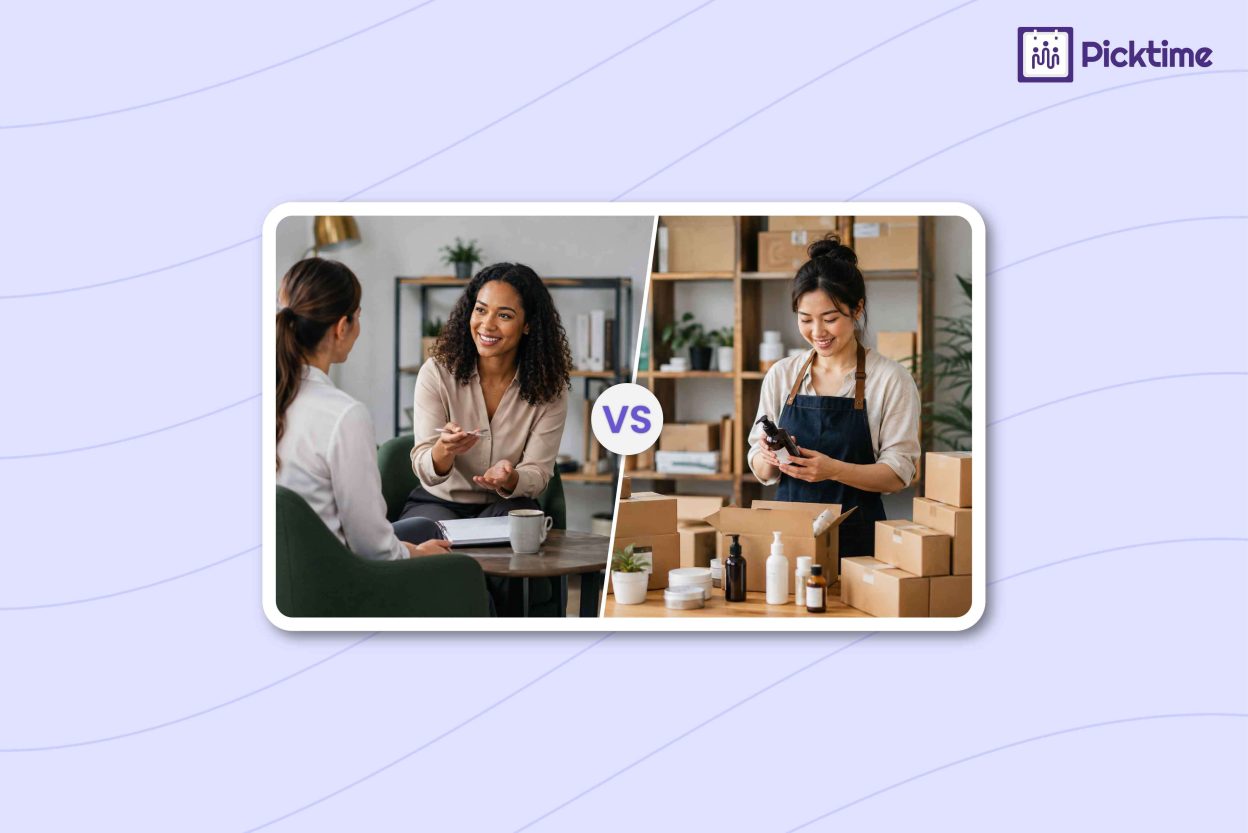
The clearest difference is what your customer is paying for. In a service business, the customer usually pays for someone’s time, expertise, skill, or access to a scheduled service. In a product-based business, the customer pays for an item created or prepared for sale.
This difference changes how each business operates from day to day. A service company may spend more time managing appointments, staff schedules, customer relationships, no-shows, and available capacity. A product company is more likely to focus on inventory levels, suppliers, production costs, order volume, shipping, and fulfillment.
Growth varies for different types of business models. Without increasing your team capacity, a product business can often sell more products in the same place. However, a service business usually becomes more profitable by making better use of the time and resources it already has. If customer volume increases, the business may require more team members, add equipment, rooms, or open a new location.
How to Choose the Right Model to Begin
When choosing between a service business and product-based business, think about a few practical questions:
- If your main strength is a skill, professional expertise, or a personal service people are willing to pay for, a service business may be the better fit.
- Some customers want personal attention, appointments, or expert support. Others would rather buy a product when they need it without much direct interaction.
- Product businesses may require spending on stock, packaging, storage, and production. Service businesses can sometimes start with lower inventory costs, although equipment, licenses, team members, and workspace can still add to expenses.
- If a service business grows, there is more room for customers, bookings, and staff to manage. However, for a product business, growth looks different. You need to keep enough inventory and production based on customer demand.
- You do not always have to choose only one. A salon can offer appointments and sell hair care products, while a fitness studio can run classes and sell merchandise. When both support the same customer need, combining services and products can create another source of revenue.
Conclusion
If you are still struggling to take a decision which one you should choose, you must know that both businesses play an important role in the economy. Many business owners combine both service and product offerings to grow their business and provide a better customer experience. However, often service business owners manage admin tasks with manual scheduling and face plenty of scheduling mistakes.
That’s where online appointment scheduling software like Picktime is specially designed for service-based businesses, so admins can make the scheduling side easier to handle. It’s not only restricted to scheduling, as the system also manages appointments, team schedules, classes, resources, customer bookings, reminders, and online payments. It reduces unnecessary scheduling gaps, saves time, and improves customer relationships.
If your calendar is becoming harder to manage as bookings increase, try Picktime to organize your scheduling and make booking easier for your customers.
FAQs
1. How can a service-based business manage appointments more efficiently?
Using an online appointment scheduling system can make bookings easier to organize. Instead of managing appointments through phone calls, messages, or separate calendars, businesses can keep schedules in one place. With Picktime, service businesses can manage appointments, staff schedules, classes, resources, customer bookings, reminders, and easy online payments from one system. Customers can also book available times without needing staff to arrange every appointment manually.
2. How does scheduling affect the growth of a service-based business?
Scheduling directly affects how much available time a service business can use. Empty appointment slots, double bookings, missed reminders, or unclear staff availability can reduce capacity and create unnecessary work. With Picktime’s online booking software, businesses can easily see when employees are available, what appointment times are open, and which resources are being used. This becomes more important as bookings and team size increase.
3. Can product-based businesses also provide services?
Yes. A product business can add services related to its products. For example, a product company may provide installation, maintenance, training, or consultations. This creates a hybrid business model where revenue comes from both products and services.