
Key Takeaways:
- A hosted booking page is a simple way to let customers view services, check availability, and book appointments online without building a full website.
- A business website gives you more space to explain your services, build your online brand presence, publish content, and attract visitors through search engines.
- A hosted booking page is often enough for solo providers, new businesses, and small teams that already get customers through social media, referrals, directories, or Google Business Profile.
- A full website can be more useful for growing businesses that need service pages, location pages, FAQs, reviews, portfolios, or other content before customers are ready to book.
- You do not always have to choose one over the other. Many service businesses use a website to attract and educate customers, then send them to a dedicated booking page to complete the appointment.
- With Picktime, businesses can create a hosted booking page and manage services, appointments, staff schedules, classes, resources, reminders, payments, and availability from one place.
- If you already have a website, you can connect your booking experience to it so customers can move from learning about your business to booking an appointment more easily.
If you’ve decided to build your brand and get your business online, the next step is choosing the right way to do it. A hosted booking page provides customers with a simple view of services, check availability, and find the information they need before booking an appointment. A complete business website can give your business more power over your brand, content, SEO, and overall online presence.
For many small businesses, the best option depends on what you want for your business. If you want a fast and reliable booking experience for your business, a hosted booking page can take round-the-clock bookings without the extra setup. However, if you also want to build your brand, attract an online audience through search engines, and polish your brand appearance. As your business grows, you may require both together.
So, which option is right for you? This guide compares hosted booking pages and full websites so you can choose based on your budget, current needs, and growth plans.
Table of Contents
What Is a Hosted Booking Page?
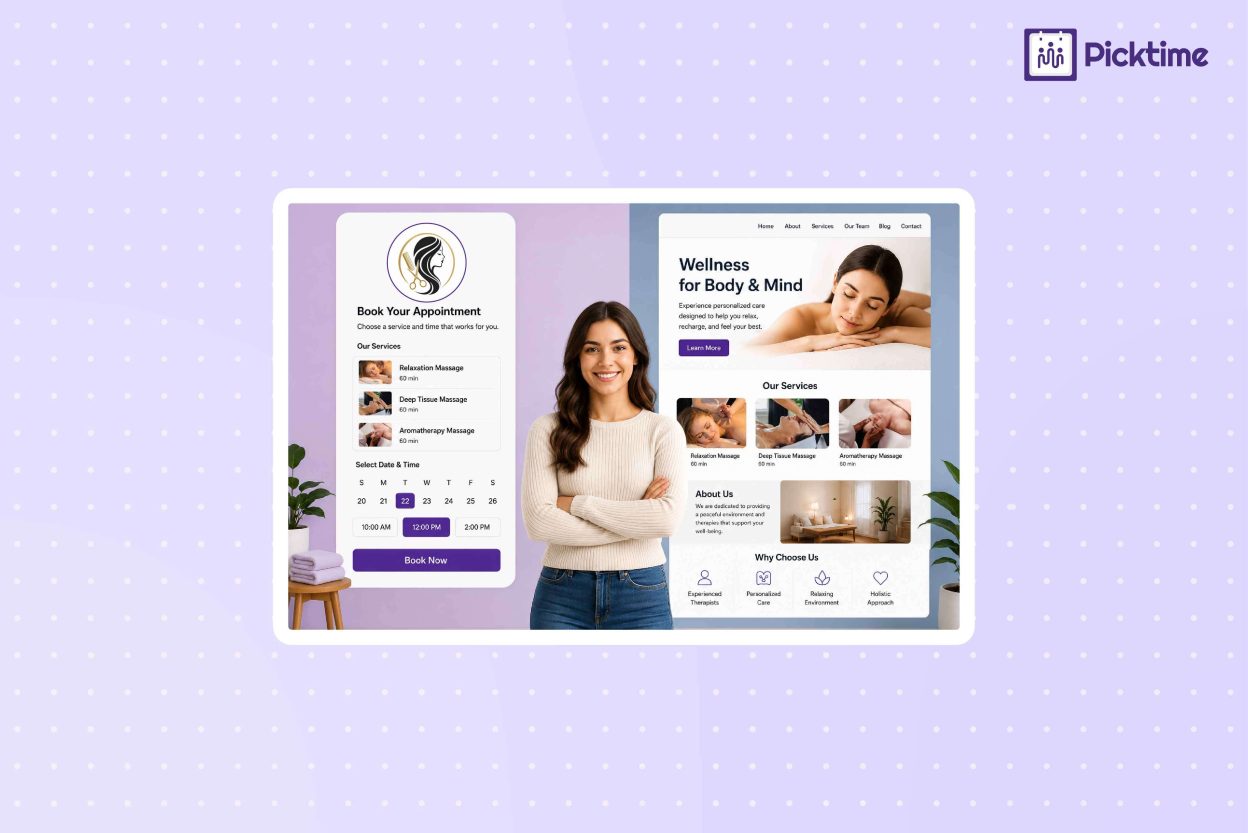
A hosted booking page is an online appointment booking page provided by scheduling software. For business admins, it’s easy to showcase your services, team availability, business hours, prices, and booking rules. Therefore, customers can then open your booking link, choose what they need, select an available time, and confirm their appointment.
A booking page acts as an online booking site that offers multiple customization capabilities to match your brand’s presence. For example, appointment scheduling software like Picktime offers a branded booking page for each business. Businesses can easily customize each booking page with crucial elements, so that clients don’t have to call or DM team members just to confirm an available slot. A hosted booking page can provide:
- Real-time availability: Customers see available time slots based on your schedule.
- 24/7 self-booking: Customers can schedule appointments even when your business is closed.
- Service and staff selection: Customers can choose the service or provider they want.
- Customer information collection: You can collect the details needed for each booking.
- Online payments: Depending on your scheduling software, customers may be able to pay a deposit or the full amount while booking.
- Confirmations and reminders: Automated messages help customers keep track of their appointments.
- A shareable booking link: You can send customers directly to the place where they can schedule.
📌Best for: solo providers, new businesses, small teams, and businesses that already attract customers through referrals, social media, directories, or local listings.
A hairstylist, tutor, coach, consultant, or other service provider may not need a large website to begin accepting appointments online. That’s where a hosted booking page can cover the most important part of the customer journey: turning interest into a confirmed booking.
What Is a Business Website?
A business website gives you a broader online presence. Rather than focusing mainly on appointment booking, it gives customers more ways to learn about your business. You can create pages for your services, team, pricing, locations, reviews, FAQs, portfolio, contact details, and other information that helps customers decide whether to choose you.
A website also gives you greater control over branding and content. You can decide how pages are structured, what information appears, and how visitors move through the site. Another major advantage is search visibility. A well-planned website can target searches related to your services and locations. For example, a dentist, salon, or massage therapist can create useful service and location pages that help potential customers discover the business through Google. A full website is especially useful when customers need more information before they are ready to book.
📌Best for: established businesses, businesses that rely on organic search, companies with several services or locations, and brands that need more space for marketing and educational content.
Hosted Booking Page vs. Full Website
Both options can help customers book appointments, but they serve different purposes.
| Hosted Booking Page | Full Website |
| Can serve as your complete online appointment booking site | Serves as the broader online home for your business |
| Lets customers view services and book in one place | Can include booking alongside service, company, and marketing pages |
| Shows available appointment times in real time | Usually needs scheduling software to display live availability |
| Gives you a direct booking link to share anywhere | Customers may move through several pages before reaching booking |
| Allows customers to book 24/7 | Online booking depends on the scheduling system connected to the website |
| Can collect customer information during booking | May use separate forms or tools for inquiries and customer details |
| Can support deposits or online payments | Payment options usually depend on the booking or payment tools connected |
| Can send appointment confirmations and reminders | A website alone usually does not manage appointment communication |
| Usually allows basic business branding | Gives you greater control over the full design and brand experience |
| Requires less setup and maintenance | Requires more time to build, update, and maintain |
A hosted booking page focuses on helping customers complete an appointment booking. A full website supports the broader customer journey, from discovering your business to learning about your services and eventually booking.
Do You Need a Booking Page, a Website, or Both?
Your choice should match how customers currently find and book with your business.
Choose a Hosted Booking Page If:
A hosted booking page may be enough if:
- You are a solo provider or small team.
- You want to start accepting online appointments quickly.
- Customers already find you through referrals, social media, directories, or Google Business Profile.
- Your main online goal is getting customers from interest to booking.
- You do not need several marketing or content pages yet.
For example, a salon owner who gets most customers through Instagram and referrals may only need one clear booking destination. Instead of asking customers to send a DM or call to check availability, the business can direct them to a booking page where they can choose a service and an available time themselves.
Choose a Full Website If:
A full website becomes more useful when:
- You want customers to discover your business through Google search.
- You need separate pages for different services or locations.
- Customers need to see a portfolio, reviews, case studies, or detailed information before booking.
- Content marketing is part of your growth strategy.
- You want more control over your website design and branding.
For example, a multi-location salon may want separate pages for each location, detailed treatment pages, stylist profiles, pricing information, FAQs, and educational content. A full website gives the business space to organize this information while still directing visitors toward an appointment.
Use Both If:
For many growing service businesses, the strongest setup is a full website connected to a dedicated online booking system. Your website helps prospects learn about your business, while your online booking site lets visitors explore your services and book right away. If a visitor is ready to take action, the button redirects them to your online booking page, while clients can see available times and choose an appointment. Picktime booking widget helps business owners add a “Book Now” button to important pages like the blog, landing pages, or the pricing page.
This approach gives your business room to grow. You can set up your branded booking page and start taking appointments right away. Your booking page provides a simple place to schedule with you, while your website helps a wider audience discover your business and learn about what you offer.
Final Verdict: Which Makes the Better Appointment Booking Site?
The better option depends on what your business needs customers to accomplish online. If your priority is making appointments easy to book, a hosted booking page can give you everything you need without the time and cost of building a complete website. If you also want to build search visibility, publish content, explain complex services, or strengthen your brand online, a full website gives you more room to grow.
And you do not have to treat them as competing options. A business can use its website to attract and educate customers while using a dedicated booking page to make scheduling simple. Picktime supports both of these approaches. You can create a hosted online booking page for your services, classes, staff, and resources, then share the booking page link wherever customers can easily find your business. If you already have a website, you can also connect your booking experience to it. Picktime helps you manage appointments, staff schedules, calendar availability, reminders, payments, and multiple locations from one place.
Whether you are setting up online booking for the first time or improving an existing website, the goal stays the same: make it easy for customers to find an available time slot and book without unnecessary steps.
Ready to make online booking easier for your customers? Create your free Picktime account and set up your booking page.
FAQs
1. Can I use Picktime without having a website?
Yes. You can use Picktime even if you do not have a business website. Picktime gives you a hosted online booking page that you can share with customers through social media, email, Google Business Profile, directories, or anywhere else you promote your business. Customers can open the link, check availability, and book directly.
2. Can a Picktime booking page work as my appointment booking site?
Yes. For many solo providers and small businesses, a Picktime booking page can work as the main place customers go to schedule appointments. You can display your services, staff availability, business hours, and other booking information while giving customers a direct way to choose an available time.
3. Can I add Picktime to my existing website?
Yes. If you already have a website, you can connect your booking experience to it. For example, you can add a Picktime booking widget or a “Book Now” button to relevant pages. Customers can learn about your services on your website and move directly to the booking process when they are ready.
4. Can customers book appointments through Picktime when my business is closed?
Yes. Customers can use your Picktime booking page to book available appointment times online even outside your normal business hours. They will only see the time slots you make available, so you can continue accepting bookings without having someone respond to every call or message.
5. Can Picktime collect online payments during booking?
Yes. Picktime supports online payments through integrations such as Stripe, PayPal, and Square. Depending on your setup, customers can pay while making their booking. This can make the booking process more convenient and reduce the need to handle payments separately.